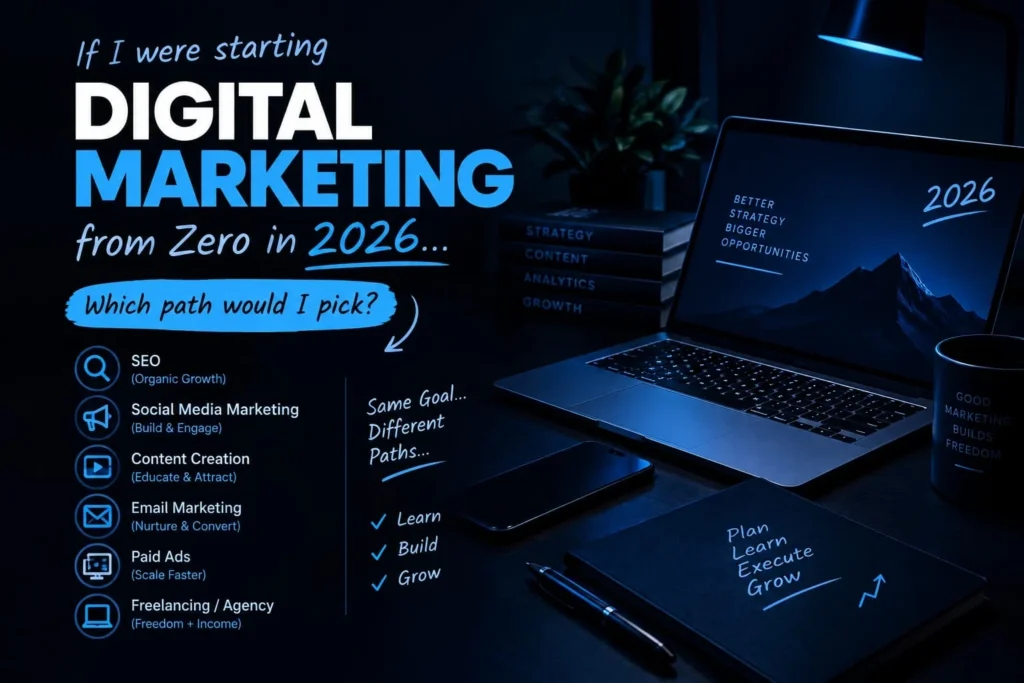
If you were starting digital marketing from zero in 2026, which path would you pick?
If I Were Starting Digital Marketing From Zero in 2026, Here’s Exactly What I’d Do Every year someone tells me digital marketing is “too saturated now.” Every year they’re wrong — the field just keeps shifting shape. In 2026 it’s shifted again, hard, around AI. But here’s the thing nobody says loudly enough: AI hasn’t replaced marketers, it’s replaced the marketers who refused to specialize. So if I were starting today, dead broke, zero experience, this is the path I’d actually take — not the “10 skills you need” listicle version, the real one. Step 1: Pick one lane, not five The old advice was “learn a bit of everything — SEO, ads, email, social.” Skip that. Spreading thin used to be a decent strategy when the bar was low. It isn’t anymore. I’d pick one specialty — content, paid ads, or email/lifecycle marketing — and go deep before going wide. Depth is what gets you hired now; breadth is what AI tools already do for free. Step 2: Get functional with AI tools immediately, not eventually Not “learn about AI” in the abstract. Actually use it daily — for drafting copy, analyzing data, building ad variations, researching keywords. The skill that matters in 2026 isn’t knowing AI exists, it’s knowing how to direct it well enough that your output beats someone else’s raw prompt. Employers aren’t asking “do you know AI” anymore, they’re asking “can you get better results with it than the next candidate.” Step 3: Build one real thing, not a portfolio of theory Start a blog, a small Instagram page, a newsletter — anything with a real audience, even an audience of twelve people. Run actual campaigns on it. Track actual numbers. A messy real project with honest results beats a polished fake case study every time an interviewer asks a follow-up question. Step 4: Learn to read data, not just collect it Anyone can pull a report. The people who get promoted are the ones who can look at a dashboard and say “this number means we should stop the campaign” or “this is why conversions dropped Tuesday.” That instinct is learnable, but only through repetition — so tie it back to Step 3. Your own project is where you practice this cheaply. Step 5: Get one credible certification, don’t collect them A single relevant certification (Google Ads, Meta Blueprint, or one from your chosen specialty) is enough to signal legitimacy. Stacking ten badges from random platforms reads as busywork, not expertise. Step 6: Network like you mean it Comment on posts, DM people doing the work you want to do, ask specific questions instead of “can you mentor me.” One honest conversation with someone a few steps ahead of you is worth more than a month of tutorials.If I had to compress this into one sentence: specialize early, get hands-on with AI immediately, and prove it with something real — everything else is noise dressed up as strategy.